
This guide explains Medicaid services, outlines the free benefits children with Medicaid receive, and provides key resources to help families apply, navigate plans, and access care.
Author: manda.hufstedler@duke.edu
Medicaid Overview for Families
This guide explains Medicaid services, outlines the free benefits children with Medicaid receive, and provides key resources to help families apply, navigate plans, and access care.

Interpersonal Violence (IPV) Integrated Care Rounds (April 2025)
Description
NC InCK's April 2025 Integrated Care Rounds discuss interpersonal violence (IPV) and resources that can help strengthen protective factors and reduce harm.
Click this link for the April 2025 Interpersonal Violence Slide Deck
Key Takeaways
- Interpersonal violence is widespread and has great financial and psychological impacts on survivors. The daily work care managers do with families, such as connecting to economic, behavioral health care, and parenting supports, increases protective factors and reduces harm from IPV.
- Understanding the warning signs and stages of abuse can help care managers screen and talk with clients about IPV. Best practices for screening include asking in private, providing multiple opportunities for disclosure, and being prepared to offer resources and safety planning when discussing IPV. A variety of assessment and safety plan tools are available in the slide deck.
- When talking with someone about IPV, it is important to be empathetic and non-judgmental in your approach. It is important not to pressure individuals to share information or take steps they are not ready for. Instead, they should be offered options for support and given space to make decisions when ready.
Resources
- Durham Crisis Response Center (DCRC): DCRC works to end domestic, sexual, and family violence, and human trafficking in Durham County, NC through advocacy, education, support, and prevention.
- Friend to Friend: Friend to Friend is a non-profit organization in Moore County, NC dedicated to helping survivors of domestic violence, sexual assault, and human trafficking.
- National Domestic Violence Hotline: Call 1-800-799-7233 or text “START” to 88788 for 24/7 support. Explore the website for resources to help identify abuse, plan for safety, and support others.
- North Carolina Coalition Against Domestic Violence (NCCADV): NCCADV provides a searchable database of local domestic violence agencies in all 100 counties across North Carolina. They offer supports that include 24-hour confidential crisis hotlines, emergency shelter, support groups, and counseling.
- NC InCK Interpersonal Violence Resources: This document includes interpersonal violence support resources for Durham, Orange, Alamance, Granville, and Vance counties in NC as well as national, statewide, and surrounding county resources.
Student Researchers Present NC InCK Care Management Findings at Academic Pediatric Association Region IV Conference 2024
NC InCK student researchers Claire Sibold and Hartlee Lidsky showcased their research on care management at the Academic Pediatric Association (APA) Region IV Conference. Their findings highlight the impact of NC InCK’s holistic and collaborative approach to care management.
Children identified for care management often experience complex medical, behavioral, and social challenges. Lidsky's work aimed to understand engagement with care management and identify important drivers of retention. This study revealed that while many caregivers were initially unfamiliar with care management, they valued the personalized support once they engaged.
Additionally, data showed that caregivers were more likely to stay engaged when communication is flexible, and care managers are compassionate and nonjudgmental. “A good care manager makes all the difference,” one caregiver noted. “I see her name and immediately feel relieved—she’s someone I can trust.”

Hartlee Lidsky presenting her findings titled, “Engaging Caregivers in Care Management: Mixed-Methods Lessons from NC InCK”
Findings from Sibold’s work similarly emphasized the effectiveness of NC InCK’s care managers when working with children from the foster care system and highlighted the impact of NC InCK’s ability to bridge gaps between siloed systems.
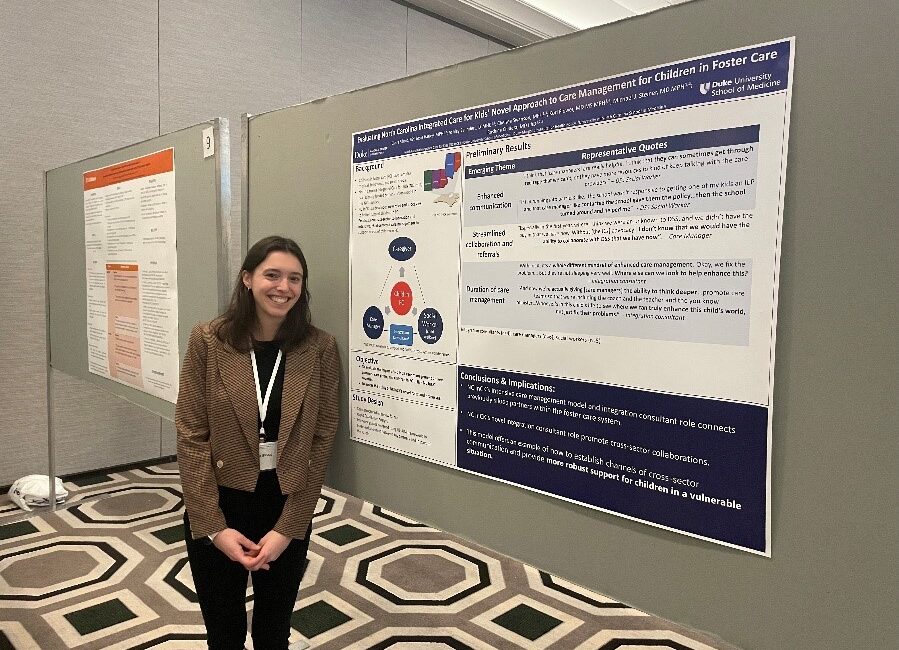
Claire Sibold in front of her poster titled, “Evaluating North Carolina Integrated Care for Kids’ Novel Approach to Care Management for Children in Foster Care”
A social worker interviewed for the study shared, “Care managers can sometimes get through red tape that we can't, and they have more resources to keep advocating for the child.” Another participant emphasized the value of deeper engagement, and the value of including everyone in the child’s life including teachers, coaches, even faith leaders, to support long-term growth.
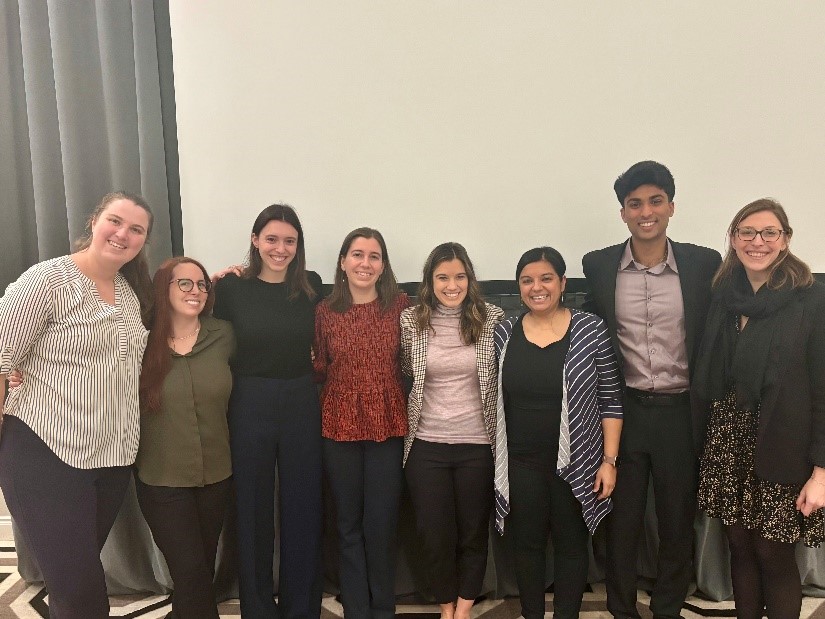
NC InCK team and student researchers at the APA Region 4 Conference
With these insights, NC InCK continues to refine its approach and prove how comprehensive and collaborative care models can make a significant difference in the lives of children and families.
Biographies:
Claire Sibold is a third-year medical student at Duke University School of Medicine, originally from Massachusetts. She graduated from Davidson College in 2020 with a major in Biology and minor in Health and Human Values. Claire's research focuses on care management in foster care. She is passionate about implementing comprehensive systems of support for vulnerable patient populations. At Duke, she is in the Primary Care Leadership Track and plans to pursue a career in family medicine, where she can care for patients of all ages within her community.
Hartlee Lidsky, MPH, is a medical student at the UNC School of Medicine and graduate of the UNC Gillings School of Global Public Health. In July 2025, she will begin an Internal Medicine-Pediatrics residency at the University of Michigan. She is interested in health services research and Medicaid policy as mechanisms to improve care for historically underserved populations; and plans to pursue a career focused on care for socially and medically complex hospitalized patients.

Family Engagement Research Part 2 Integrated Care Rounds (February 2025)
Description
Check out NC InCK's February 2025 Integrated Care Rounds where we dive into findings from our conversations with families engaged with the NC InCK care model.
Click this link for the February 2025 Family Engagement Research Part 2 Slide Deck
Key Takeaways
- Families who chose not to participate in NC InCK care management expressed skepticism about the usefulness, legitimacy, and/or confidentiality of care management.
- Many of these families were unfamiliar with care management and made assumptions based on prior negative experiences with the healthcare system or other social services.
- Families who initially participated but then were lost to follow up often talked about competing priorities (work, childcare, life events, health challenges) that made it hard to keep up with regular scheduled care management phone calls during business hours. Texting was helpful to keep busy families connected.
- Others felt they hadn’t received services they expected to receive, like financial or housing assistance, because resources weren’t available or there were long wait lists
- Many families in both groups were interested in being reconnected to the program, either because they felt they had a better understanding of care management or because their needs had changed since the initial outreach.
NC InCK: 2024 in Review
The end of 2024 marks the third anniversary of NC InCK’s launch. Since 2022, the model has demonstrated the power of integrated care, serving roughly 3,000 children and families across five counties.
This year, NC InCK aimed to understand which model components have the greatest impact on child and family wellbeing and how these components can be improved and sustained in the future.

Feedback from families engaged in the NC InCK model
Area 1: Understand Needs
In 2024, NC InCK continued to use integrated data systems that combine information from Medicaid, schools, social services, and juvenile justice agencies to identify children who may benefit from care management and assign them one of three Service Integration Levels (SILs). Children in SILs 2 and 3 are prioritized for outreach by care managers. Each month of 2024, the SIL algorithm prioritized over 1,000 families for care management outreach.
A key focus this year has been understanding which children and families are being elevated for care management and which may be missed. One early finding from this work is that the algorithm may miss very young children who have fewer interactions with health and social systems, indicating that alternative pathways to engage this population may be necessary. Additional analyses will continue in 2025 to give NC InCK a clearer picture of the most important data in identifying children's unique challenges.
Area 2: Support and Bridge Services
This year, the model deepened its commitment to connecting families, especially those engaged through our care management program, to essential services. Our Integration Consultants (ICs) continued to provide individualized panel management support to frontline NC InCK care managers, ongoing group trainings and written resources to build care manager capacity. Highlights from this year’s IC capacity-building work included live trainings on topics like supporting LGBTQ+-identified youth and serving families with mixed immigration statuses as well as written resources like our quick guide to connecting families to economic resources and our new resource guide on serving children and youth with special health care needs.
Through our partnerships with the Alamance-Burlington school system and juvenile justice counselors, NC InCK has continued to test and refine referral pathways for trusted community partners to connect children and families to care management. NC InCK also worked to understand how these direct referral pathways complement the model’s algorithmic risk stratification strategy to engage children and families not originally elevated for, but who might benefit from, care management. Efforts in 2025 will focus on creating referral pathways with additional school systems and organizations serving children ages birth through five.
Additionally, NC InCK has worked closely with Community Care of North Carolina (CCNC) and local DSS offices across the NC InCK counties to strengthen connections to care management for children in foster care. At the end of 2024, about 95% of NC InCK-eligible children in foster care were enrolled in care management. In 2025, NC InCK will continue to build on this exciting engagement by piloting outreach to adoptive families and having NC InCK care managers join permanency planning review (PPR) meetings alongside other cross-sector care team members.
Area 3: Focus Healthcare Investments
In 2024, NC InCK clinics received data from their first year of participation in the Alternative Payment Model (APM), which links payments to meaningful health and social outcomes. Performance reporting gives clinics actionable insights into their achievements and outlines areas for growth. In 2025, the model will continue to foster APM participation across roughly 90 clinics by highlighting and disseminating lessons learned from high-performing clinics, refining documentation workflows for APM measures, and supporting quality improvement initiatives across sites.
Highlighting Family-Centered Care
Throughout 2024, NC InCK researchers interviewed families to understand their experiences with NC InCK care management. Interviewees included both Spanish and English-speaking families who 1) engaged in NC InCK care management, 2) initially engaged but were lost to contact, and 3) declined to engage in care management. These conversations revealed that engaged families benefitted from NC InCK care managers’ empathy, ongoing support in navigating complex systems, flexibility, and whole-family focus. Caregivers cited connection to essential clinical and nonclinical resources and reduced stress as major program benefits. One caregiver talked about the impact of NC InCK’s support on her children’s physical health: “My two sons were… borderline diabetics, and within four months, they went from borderline diabetes to no diabetes at all.”
Families also revealed barriers to engagement in care management, including insufficient community-based resources to meet needs like housing instability and competing demands on their time from work and family obligations. These findings reinforce the need for both programmatic flexibility to allow families to engage on their own terms as well as systems-level efforts to invest more resources in social support programs like rent assistance. Families also identified the need for clear, concise messaging about care management, its holistic scope, and its potential benefits to busy caregivers.
These stories illustrate the impact of family-centered care in developing resilience, confidence, and well-being among NC InCK families and highlight opportunities for ongoing program improvement and care manager capacity-building. Interviews will continue into the first few months of the new year and family-centered care will remain a priority as the model progresses in 2025.
Looking Ahead
Looking ahead to 2025, NC InCK aims to create an even more impactful and inclusive care model by continuing to update data integration strategies, strengthen direct referral pathways, develop new resources and supports for care managers, and share lessons learned with key partners to improve pediatric care management practices.
To learn more about how NC InCK is committed to creating more equitable care, join Integrated Care Rounds throughout the year and visit the Training, Resource, and Core Child Service Area web pages. Follow along as NC InCK strives to improve children’s health and well-being.
Authors:

Ali Kilborn supports NC InCK as a Clinical Research Communications Specialist through the Duke Clinical Research Institute. As a communications specialist, Ali strives to promote health literacy by translating complex scientific information into easily understandable formats. Ali earned her Bachelor of Arts in Psychological and Brain Sciences focused on cognitive neuroscience at George Washington University and completed a post-graduate certificate in Pre-Medical Studies at Johns Hopkins University.

Chelsea Swanson serves as an Assistant Research Director within the Duke-Margolis Institute for Health Policy, and as the Managing Director for the NC Integrated Care for Kids (NC InCK) Model. Chelsea holds a Master’s Degree in Public Health from the Gillings School of Global Public Health at the University of North Carolina at Chapel Hill where she studied how systems and behaviors can drive equitable healthcare access.

Eleanor Wertman is the Director of Care Integration for North Carolina Integrated Care for Kids (NC InCK). She holds an MPH from UNC Gillings School of Public Health and has a background in health care quality improvement and value-based care. Prior to joining the InCK team, Eleanor worked for UNC Population Health, where she developed programs to address UNC patients’ nonclinical barriers to health, including a Medicare transportation program and a community health worker team. She also supported system-wide implementation of social drivers of health screening at UNC Health. She now leads implementation of the NC InCK care management and alternative payment models.
NC InCK is Hiring a Senior Program Coordinator
NC InCK is looking for a Senior Program Coordinator who will help advance its mission of improving health outcomes for children and families.
In this role, the Program Coordinator will organize events, including Partnership, Family, and Youth Council meetings, support operational needs, assist in development strategy, and collaborate with cross-sector partners.
The ideal candidate will have experience creating and maintaining structures that support work across teams and competing priorities, have strategic planning and partnership development expertise, and be committed to advancing health equity and innovation.
NC InCK Youth Council Voices: Nasir N.
Meet Nasir, a high school senior and dedicated member of the NC InCK Youth Council. As the president of the East Investment Club, Nasir leads many initiatives, such as stock market games and competitions, to encourage financial responsibility among his peers. Outside of school, he is a dedicated pianist and composer, aspiring to create music for films, television, and video games. Additionally, Nasir is an active member of the National Achievers Society, where he helps plan cultural events at his school. With two years of experience on the NC InCK Youth Council, Nasir is focused on making lasting connections, gaining insight into community change, and expanding his collaborative experiences. Hear more from Nasir below.
Responses have been edited for clarity and readability.

Nasir N., NC InCK Youth Council member
When talking about the adolescent and young adult population, what does "Strength-Based" action mean to you?
Nasir: I believe that in being Strength-Based, NC InCK promises not to undermine the talents, skills, and strengths that the parents, communities, and youth they serve already hold. Instead, NC InCK will identify and uplift individual strengths while working to overcome any weaknesses.
In the youth population, this means finding the unique talents of a community member and supporting them as they explore and build on that skill. This may include introducing the youth to possible career paths, extracurriculars, and opportunities outside of what would otherwise be found.
Why is it important that we focus on the adolescent and young adult experience?
Nasir: Often, the trajectory of someone’s life is determined by their childhood and adolescent experiences. Of course, this trajectory can be changed later in life with hard work and determination, but it is far more difficult.
Supporting adolescents and young adults during this time in their lives is the best way to help those who may have had a worse hand dealt to them.
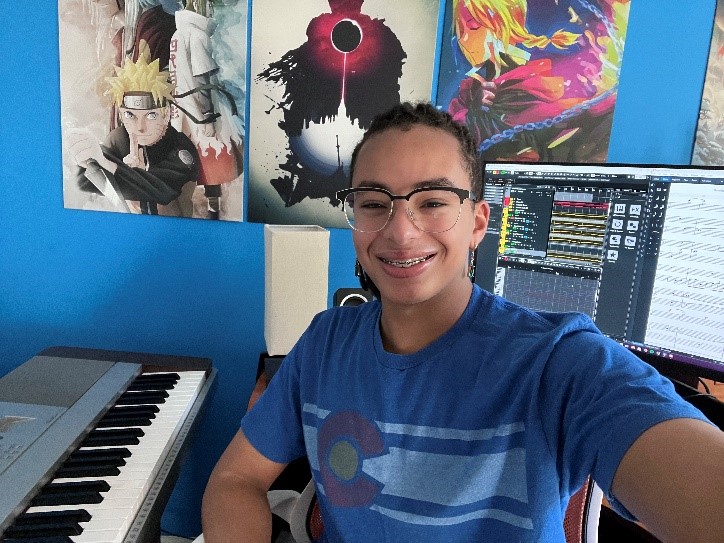
Nasir with his keyboard and composing equipment
How have monthly Youth Council meetings impacted your understanding of child and family-led community programs and partners?
Nasir: With resources like frequent guest speakers, the monthly Youth Council meetings have helped me learn more about programs within the community. Through this interaction, I’ve learned over time what these types of programs provide and who they support.
How does the Youth Council help NC InCK incorporate the adolescent and youth-adult experience into their decision-making?
Nasir: The Youth Council helps NC InCK consider the adolescent and youth-adult experience by including multiple youth voices who all offer a unique perspective. It is important to incorporate different viewpoints into the decision-making process. Our strength ultimately comes from the collaboration between the Youth Council and the larger NC InCK organization, both of which have the common goal of equitable assistance.
Juvenile Justice Adolescent to Adulthood Resource Guide
This guide provides NC InCK Family Navigators (FNs) with an extensive, though not exhaustive, list of potential discussion points, tips, and resources for supporting adolescents and young adults in the NC InCK care model who are involved with the juvenile justice system.
Bringing NC InCK Care Management Insights to a National Audience
Although NC InCK is a pediatric model, data on care management can provide valuable lessons relevant to any entity aiming to improve population health.
This October, Eleanor Wertman, NC InCK Care Integration Director, shared insights about implementing care management at the National Association of Accountable Care Organizations (NAACOS) Fall Conference. About 700 attendees discussed how to improve population health and health care quality. Stephanie Turner of UNC Health Alliance and Tara Kinard of the Duke Population Health Management Office co-presented NC InCK’s data with Wertman in a session titled “Shaping Future Health: Upstream Care Management Strategies for High-Needs Populations.”
Wertman’s portion of the session focused on how the NC InCK model aims to set children and families up for long-term well-being and how it differs from traditional care management approaches. Here, Wertman discussed NC InCK’s prioritization of families for care management who are at high or rising risk of poor health and how their risk stratification algorithm uses nonclinical data to identify families with high rates of unmet social needs that threaten children’s health. This approach allows care managers to reach rising-risk families earlier and mitigate negative health outcomes.
The presentation also covered how family-centered care management has benefitted entire households, not just the children originally identified for engagement. Over the last few months, NC InCK has conducted qualitative interviews with families to better understand how care management can improve children’s health. Interviewees emphasized the importance of nonjudgmental and meaningful support; intensive, longitudinal assistance; and connections to essential resources. Families repeatedly noted the program’s positive impact on their children and, in turn, their households’ overall well-being. NC InCK Family Navigators helped caregivers be more present and available for their children by alleviating administrative burdens, financial strain, and health stressors.

Co-Presenters Stephanie Turner, RN, MSN, Vice President of Population Management for UNC Health Alliance; Eleanor Wertman, MPH, Care Integration Director for NC Integrated Care for Kids; and Tara Kinard, DNP, MSN, MBA, RN, CCM, ACM-RN, CENP, Associate Chief Nursing Officer, Duke Population Health Management Office before their NAACOS presentation
Historically, many population health initiatives and value-based care contracts have focused on high-cost, high-need adults. However, NC InCK’s experiences demonstrate the importance and impact of reaching children before they develop chronic conditions or other health challenges. Engaging with children early in their lives can help them thrive in the long term and deliver immediate health improvements for their entire family, including adults. NC InCK was honored to share this important work and advocate for the importance of child and family-focused approaches to population health!
Author:

Eleanor Wertman, MPH is the Care Integration Director for NC Integrated Care for Kids, where she co-leads implementation of the care management model and leads the program’s Alternative Payment Model. Eleanor has a background in helping health care systems design and launch programs that address patients’ nonclinical barriers to health and well-being. Prior to joining InCK, she worked on health care quality improvement initiatives, built and led a community health worker team at UNC, and led a mobile COVID vaccination unit. She holds a Master of Public Health from UNC Gillings School of Global Public Health and a BA in History from Yale University.