North Carolina Integrated Care for Kids (NC InCK) aims to share what we've learned with the broader community. Our recent publications—including work led by students and trainees—examine how families and partners experience the NC InCK model’s design and approach, how NC InCK identifies children who may benefit from extra support, and what it takes to finance whole-child care more broadly.
Start with the NC InCK foundations
An overview in Healthcare, "An introduction to North Carolina Integrated Care for Kids (NC InCK): A model to support whole-child health,” describes the design of the NC InCK model, including our approach to cross-sector risk stratification, family-centered care management, and an alternative payment model that includes measures of social needs and school readiness.
Families want flexibility
A qualitative study in Health Services Research, “Engaging Families in Pediatric Care Management,” examines caregiver participation in NC InCK. Research intern Hartlee Lidsky, MD, and our team found that clear messaging and simple eligibility criteria, plus care managers who can build relationships with caregivers from many backgrounds, all help with encouraging caregiver participation. Because families' needs and capacity change over time, flexible options are needed rather than a one-size-fits-all approach.
Foster care partners saw stronger connections
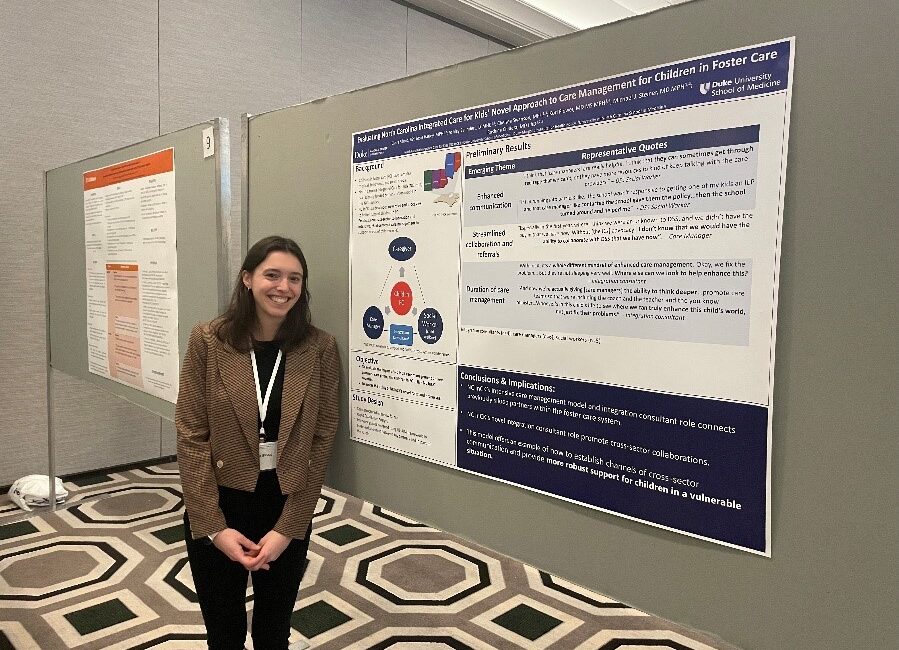
In “Cross-partner Perspectives on a Novel Approach to Care Management and Systems Coordination for Children in Foster Care” published in Academic Pediatrics, research intern Claire Sibold, MD, and NC InCK team members interviewed care management and social work professionals as well as caregivers of children placed in foster care who were receiving NC InCK care management. Stakeholders said the program linked parts of the foster care system that had previously operated in isolation, reducing the burden on individuals to navigate a complex and fragmented system.
Looking beyond healthcare data
In a new preprint, “Beyond Healthcare Utilization: A Whole-Child, Multi-Sector Approach to Pediatric Risk Stratification,” we describe how NC InCK combines health, education, social, and juvenile justice data to assign children to Service Integration Levels (SILs). Among about 99,600 Medicaid-enrolled children in our five-county region, roughly 5.5% were placed in Level 2 and 4% in Level 3. About one in five to one in four of these children had been rated low risk by their Medicaid managed care organization, suggesting that non-clinical factors help identify children who might otherwise be missed.
Paying for whole-child health
In “Advancing Financing Arrangements for Whole-Child Health: Challenges and Opportunities in Pediatric Value-Based Care” published in Pediatric Clinics of North America, NC InCK's Eleanor Wertman, MPH, and Rushina Cholera, MD, PhD, join Stephanie Ryan, MPH, and Charlene Wong, MD, MSHp, in examining what accountable care can mean for children. These researchers highlight evidence that accountable care can reduce hospital use and costs, while emphasizing that addressing social needs may require longer-term investment. They also identify Medicaid policy and contract design—including pediatric-specific quality measures, care management payments, social-needs supports, and data sharing—as key levers for progress.