What does Medicaid Expansion mean for NC InCK families?

Medicaid Expansion recently passed in North Carolina, and Governor Cooper signed the bill on March 27, 2023. Medicaid Expansion provides access to affordable health insurance coverage to an estimated 600,000 adult North Carolinians, including many adults who care for children.

The expansion of Medicaid will have an important impact on the well-being of the children and families enrolled in the NC Integrated Care for Kids (NC InCK) model.

What is Medicaid Expansion?

North Carolina has expanded income thresholds for adults who qualify for affordable health insurance through Medicaid. Income thresholds have been expanded up to 138% of the federal poverty level. For a family of three whose children are enrolled in the NC InCK model, this means that caregivers who earn up to $24,860 per year will qualify for insurance coverage through Medicaid. Medicaid coverage works similarly to other types of insurance coverage by covering the costs of key physical and mental health care services and vision and dental care.

Approximately 100,000 low-income parents with children will gain coverage through North Carolina’s Medicaid Expansion. Children are more likely to access routine preventative care, like annual well visits, when their parents also have Medicaid insurance coverage.

Medicaid Expansion is important for caregivers of children in the NC InCK model because it:

  • Provides access to preventative care for many low-income people and their families.
  • Provides access to behavioral and mental health services for many low-income caregivers and their families.
  • Reduces medical bills for low-income caregivers and their families.
  • Increases access to affordable health insurance coverage for working families, particularly those in the childcare sector, who provide early education support for children enrolled in the NC InCK model.
  • Stabilizes health care in rural areas by giving patients access to affordable health insurance, creating jobs, and strengthening the local economy.

What does Medicaid Expansion mean for NC InCK families?

NC InCK’s integrated care model focuses on working alongside families to address children’s health, education, and social service needs. Since 2020, NC InCK has worked with nine partner entities to connect families with a care manager called a Family Navigator. Since 2022, our partners have enrolled 1,500 children in the NC InCK model across five NC counties.

A Whole Family Approach to Care

Families engaged in the NC InCK model often benefit from many services that support all aspects of a child’s life. Services might include connections to a therapist, affordable housing, or creating an asthma action plan.  Many families may need services for adult family members too. Under Medicaid Expansion, NC InCK care managers will be able to better support a whole family’s needs because more children’s caregivers will have access to health insurance coverage. With this coverage, care managers can assist in coordinating supports for behavioral health care, physical health and preventive care, and the management of chronic conditions for both parents and their children. NC InCK hopes that the expansion of Medicaid will make it easier for our partner health systems to take a whole family approach to care management.

Reducing the Stress of Medical Debt

When families experience financial stress, it can harm a child’s development as well. Families enrolled in the NC InCK model are often navigating food insecurity, housing instability, and/or inconsistent transportation, which can have an impact on children, their development, and their education. Medicaid Expansion will help to reduce family medical debt, so that families will be less likely to encounter hardship impacting social determinants of health.

Improving Access to Non-Emergency Care

Chandrika Brown, NC InCK’s Family Council Chairperson, captured the importance of affordable health coverage for families like those enrolled in NC InCK when she said, “Medicaid Expansion is important for North Carolina families, especially the children and young adults. It gives families the opportunity to receive the necessary care they have often gone without. They are able to receive appropriate care instead of going to the emergency room, without fear of excessive medical bills. Medicaid Expansion is changing the lives of North Carolina families, children, and young adults.”

You can learn more about NC InCK by visiting ncinck.org.

For press inquiries, please contact Sonya Sutton at sonya.sutton@duke.edu.

allin

Sarah Allin is the Managing Director of NC Integrated Care for Kids. In her role, she oversees the day-to-day operations of the NC InCK model. Allin also serves as a Child Health Policy Fellow at the Duke Margolis Center for Health Policy and holds a Masters of Public Policy from the Harvard Kennedy School of Government.

Manda Hufstedler
Communications Specialists
she/her/hers

Manda Hufstedler is a Research Communications and Engagement Specialist at the Duke Clinical Research Institute, and she has worked with the NC InCK Communications Team since February 2021.


Happy Trails to Our Spring 2023 Interns

Over the last several semesters, the NC InCK team has had the opportunity to work with a group of phenomenal interns. Spring 2023 was no exception. From working on a capstone project involving justice-involved youth to developing resource lists for families in NC InCK’s service area, our interns have done incredible work during their time with NC InCK. Read more about our interns, their work, and what they learned below.

Lauryn Ewing
Undergraduate Intern
North Carolina Agricultural & Technical State University

Lauryn Ewing is an undergraduate social work student at NC A&T (’24) from Charlotte, NC. She worked closely with the team of Integration Consultants to create a resource list for families within three of the NC InCK counties. In May, she will begin her work as a servant leader intern ambassador with Freedom Schools Partners Inc.

“I realized how impactful the core child services are within the community and how beneficial these conversations are.” – Lauryn Ewing

Sarah Laible
Undergraduate Intern
UNC-Chapel Hill

Sarah Liable is an undergraduate Health Policy and Management student at UNC-Chapel Hill (’23) from Lehighton, Pennsylvania. Sarah worked with NC InCK for several semesters on the housing workgroup, Q3, and Medicaid Resource Guide. This year, she completed her senior honors thesis on “Evaluating the Quality of Shared Action Plans”. Throughout this research, she reviewed over 70 SAPs and conducted interviews with Family Navigators and Integration Consultants to gather insights and recommendations. After graduation, Sarah is joining Teach for America in Charlotte, NC.

“I learned that health equity work takes a team to develop meaningful goals, conquer health barriers for families, and help a child grow and develop in their community.” – Sarah Liable

April Peck

April Peck is a Public Policy Master’s student at UNC-Chapel Hill (’23) from Greensboro, NC. Throughout the Spring semester, she worked on her capstone project with NC InCK, which culminated in a report on “Addressing the Coverage Gap for NC’s Justice-Involved Youth”. The report and accompanying slide packet include information on all things juvenile justice, Medicaid, Section 1115 waivers, the consequences of the Medicaid inmate exclusion policy, and how other states are calling upon 1115 waivers to address the coverage gap.

“I learned all about juvenile justice. [It was my] first time working with the justice system! I learned about a policy affecting NC’s justice-involved youth and its negative impact.” – April Peck

Karina Vasudeva
Undergraduate Intern
UNC-Chapel Hill

Karina Vasudeva is an undergraduate Health Policy and Management and English and Comparative Literature student at UNC-Chapel Hill (’24) from Washington D.C. She worked with NC InCK over the course of NC InCK’s implementation up until Spring 2023.She worked on the development of a Housing Roadmap and Overview and the collaboration between NC InCK and the Alamance-Burlington Schools System for NC InCK’s manual referral process.

“I discovered how imperative (and yet complicated) forming coalitions across core child services is.” – Karina Vasudeva

The NC InCK team is grateful for all of your work and the experiences we had along the way! We wish each of you the very best!

NC InCK presents research at 2023 Pediatric Academic Societies Meeting

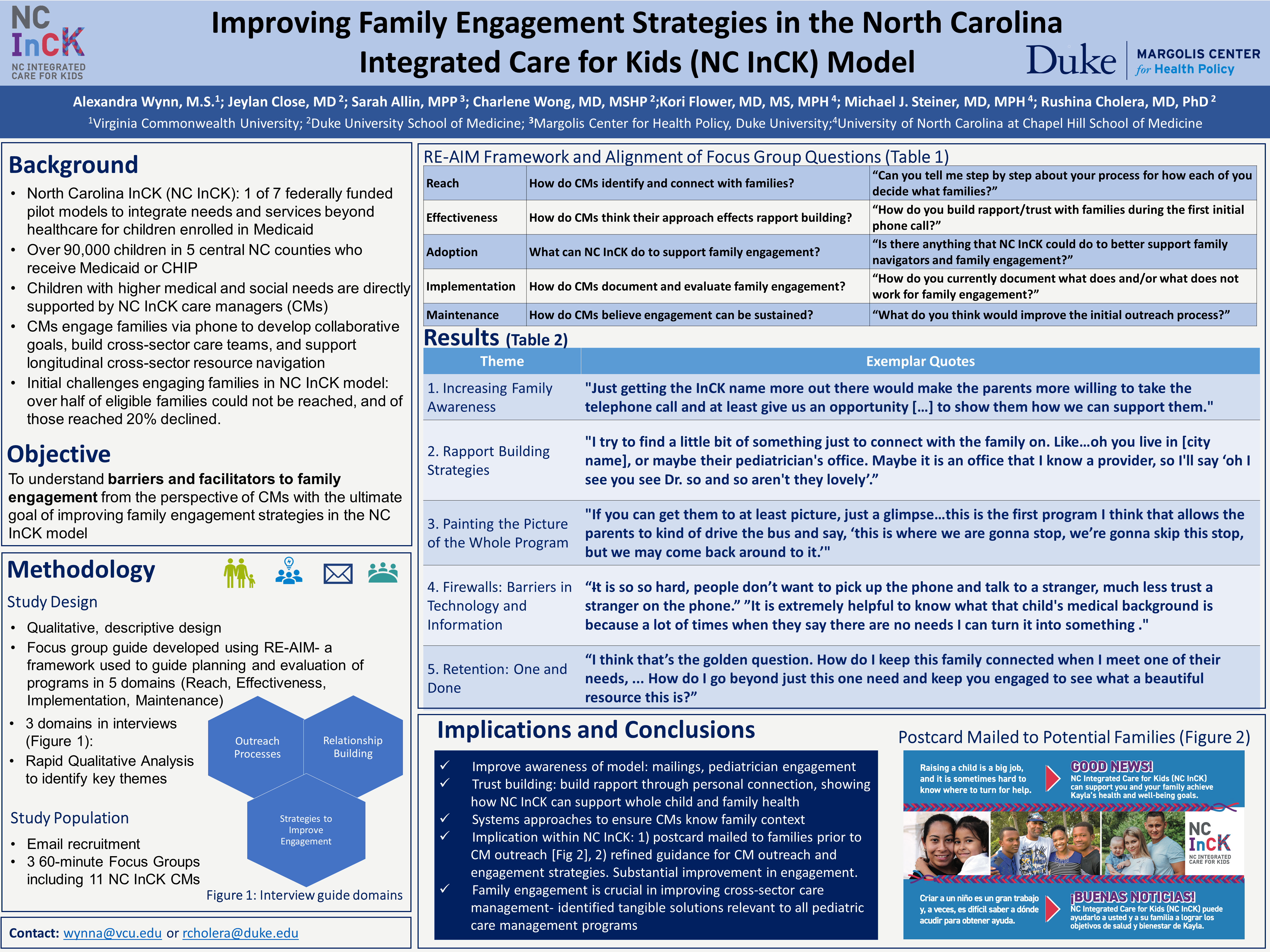
Last weekend, several members of the NC InCK team attended and presented at the 2023 Pediatric Academic Societies (PAS) Meeting. Greeshma James and Dr. Rushina Cholera presented a poster on “Driving Investment in Pediatric Alternative Payment Models: Lessons from the North Carolina Integrated Care for Kids Model”, which was the highest scoring abstract in Health Sciences Research. Dr. Rushina Cholera also presented a poster alongside Dr. Kori Flower on “Improving Family Engagement Strategies in the North Carolina Integrated Care for Kids Model”.

Driving Investment in Pediatric Alternative Payment Models: Lessons from the North Carolina Integrated Care for Kids (NC InCK) Model
"Improving Family Engagement Strategies in the North Carolina Integrated Care for Kids (NC InCK) Model"

Together, Dr. Rushina Cholera, Dr. Kori Flower, Dr. Richard Chung, Dr. Mike Steiner, and Greeshma James shared early learning from the NC InCK model and made exciting connections.

Dr. Richard Chung, Dr. Kori Flower, Dr. Rushina Cholera, Dr. Mike Steiner

NC InCK’s Sarah Allin presenting at Duke Margolis Center for Health Policy discussion 

The Duke Margolis Center for Health Policy Scholars Program will present a special event focused on leveraging community partnerships and health care coordination systems to better address social determinants of health challenges locally and nationally. This event will feature a discussion between Sarah Allin (NC InCK’s managing director), Vaughn Crawford (the director of customer success of Unite Us), and Erik Valera (the chief operation officer of El Centro Hispano). The discussion will be moderated by Elaijah Lapay (Duke University, BA’24).

The event will be held virtually on Zoom and in-person in the Sanford Rhodes Conference Room (223) on April 14 at 12pm ET. Please register for the event using this link.

NC InCK and The ABC Science Collaborative Partner to Create Resource Guides for Educators

The ABC Science Collaborative and NC InCK have developed a series of resource guides for North Carolina educators to help meet the health, education, and social needs of students and their families.

The resource guides are designed to serve as a quick reference tool for school social workers and others in North Carolina schools who may need to connect students and families with community services and resources.

The resource guides cover a number of topic areas including the following:

“With these resource guides, NC InCK and The ABC Science Collaborative aim to support school social workers by providing tools and connection to resources that may help impact the health and well-being of students and families across North Carolina,” said Kanecia Zimmerman, MD, MPH, co-chair of The ABC Science Collaborative and a pediatrician at Duke University School of Medicine.

“We hope the resource guides are a helpful reference tool for school social workers and other educators in North Carolina that will be used widely in school districts across the state,” said Dan Kimberg, Operations and Strategy Director for NC InCK.

The resource guides are part of a partnership between The ABC Science Collaborative, NC InCK, Student U, and North Carolina-Psychiatry Access Line (NC-PAL) that aims to improve the health and well-being of children in North Carolina.

NC InCK April 2022 Quarterly Webinar Recording

The April 4, 2022 NC InCK Quarterly Webinar shared highlights in understanding the needs, integrating services, and investing in what matters most for children and families as well as updates on the NC InCK model after launching this year. The NC InCK team reinforced the importance of building on the strength of our community through the Partnership, Youth, and Family Councils.

https://vimeo.com/699476590

NC InCK Launches New Model to Improve Care and Well-Being of Children Insured by Medicaid in Central NC

MEDIA CONTACTS:

Sonya Sutton, sonya.sutton@duke.edu, 919-608-0480 (m); Alan Wolf, alan.wolf@unchealth.unc.edu, 919-218-7103 (m); Robin Deacle, news@dhhs.nc.gov, 919-855-4840 (o) 

A new model led by a partnership among Duke University, UNC Health, and the NC Department of Health and Human Services is transforming how to support children’s health and well-being.

North Carolina Integrated Care for Kids (NC InCK) launched in January 2022 for children who are insured by Medicaid or CHIP (NC Health Choice) in Alamance, Orange, Durham, Granville, and Vance counties. A coalition of partners — including families, local organizations, and state leaders in the health, social, and educational needs of children — spent more than two years designing the model.

The NC InCK model (pronounced “ink”) supports integrated care for children by more holistically understanding their needs, supporting and bridging services for children and their families, and investing in what matters most to them. NC InCK builds on Medicaid’s whole-person Advanced Medical Home (AMH) care management model and practice-based incentive programs. NC InCK is bringing in additional data from schools and juvenile justice to supplement existing medical and behavioral health data to better identify children who could benefit from additional care management supports. These children and families will have the chance to work with a family navigator from their AMH or their Medicaid health plan.

The family navigator will coordinate services and supports the family needs across physical and behavioral health, early care and education, schools, housing, food, public health services, child welfare, mobile crisis response, juvenile justice, and legal aid. NC InCK also builds on AMH practice-based incentive programs and has designed an alternative payment model that rewards participating clinical practices for improving measures of overall health and well-being for children, such as well-visits, screening for depression and social needs, and school-readiness.

“Investing in children is the best way to build a vibrant future for North Carolina,” said Kody H. Kinsley, NCDHHS Secretary. “Supporting the well-being of children and their families is a top priority for the department, especially as we work to recover even stronger from the impacts of the pandemic.”

NC InCK has worked closely with NCDHHS in designing and implementing the model in the midst of the transition to NC Medicaid Managed Care to strengthen integrated care for approximately 95,000 children in central North Carolina in both managed care and in Medicaid Direct (Fee for Service).  

“The NC InCK model is bringing together multiple sectors that are critical to supporting whole child and family health,” said Dr. Charlene Wong, NC InCK executive director and assistant secretary for children and families with NCDHHS. “For example, a physician finds out in a well-child visit that a family is running out of food and the child is missing a lot of school. An NC InCK Family Navigator can connect the family with SNAP benefits, contact the school counselor, and collaborate to find ways to help the child in getting to school consistently.”

NC Medicaid has played a key role in the development and implementation of NC InCK, building on the whole person care delivery models implemented as part of Medicaid Transformation.

“For several years, NC Medicaid has been advancing the medical home model that is firmly established in North Carolina,” said Dave Richard, deputy secretary for NC Medicaid. “NC InCK offers us an opportunity to share new sources of data with our medical homes and to support local community care team collaboration so medical homes can help better support children and family with complex social and education needs.”

Families, advanced medical homes, care managers, health care providers, and core child service providers can find materials to support children and their practices at ncinck.org.

“As a physician serving children who are insured by Medicaid in these counties, I know the challenges of not being able to see the whole picture of what a child and family needs,” said Dr. Mike Steiner, NC InCK medical director and pediatrician in chief of UNC Children’s. “NC InCK will help bring all of these needs and services together to improve children’s well-being.”

“All of the coalition partners have been involved in finding the best way to reach the children in our service area,” said Sarah Allin, NC InCK managing director. “We have taken our time to make sure we are hearing the right voices and creating a model that we believe will work in our communities.”

NC InCK is one of seven InCK models in the country that were awarded up to $16 million dollars in funding from the Centers for Medicare and Medicaid Services for the 7-year model.

###

This project is supported by the Centers for Medicare and Medicaid Services (CMS) of the U.S. Department of Health and Human Services (HHS) as part of an award totaling $7,299,227 in 2022 with 0% percentage financed with nongovernmental sources. The contents are those of the author(s) and do not necessarily represent the official views of, nor an endorsement, by CMS, HHS or the U.S. Government.